
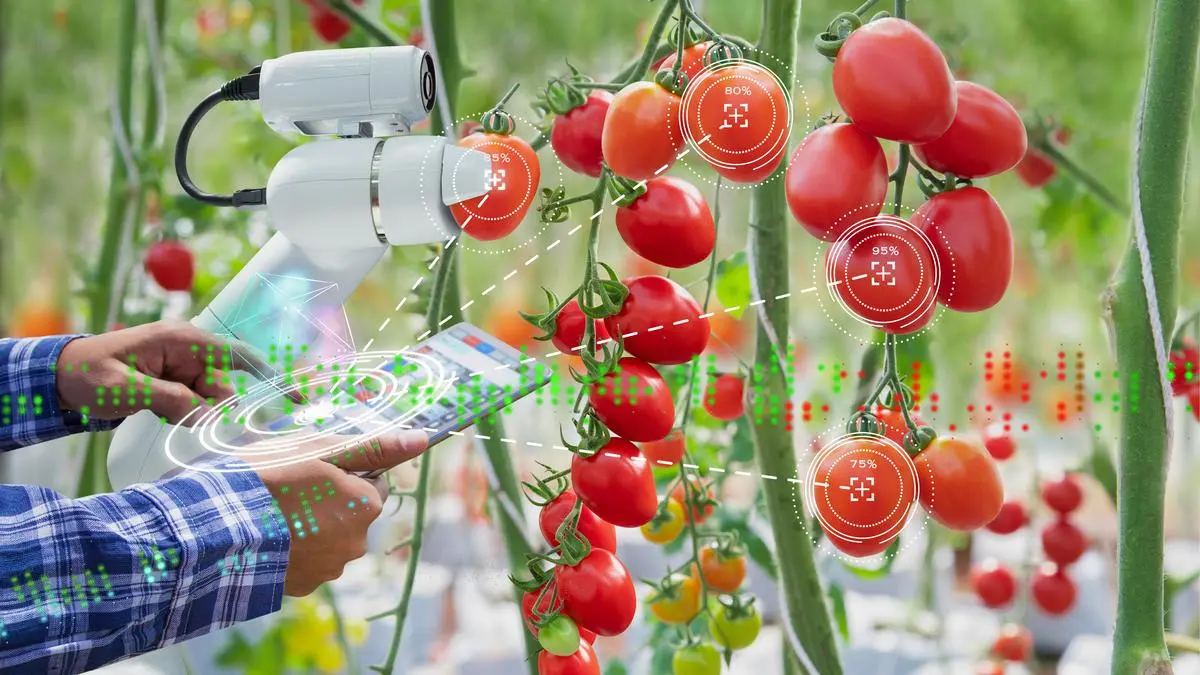
For millions of Indian farmers, the most critical tool this monsoon season isn’t a new tractor or machine, but an algorithm on their phone. As climate change makes the monsoon rains more erratic, artificial intelligence is being harnessed as a crucial line of defence, predicting weather with accuracy and safeguarding the livelihoods that depend on the Kharif harvest. The kharif season, spanning June to September, is the backbone of India’s food system. Yet, it is perennially vulnerable to the fluctuations in the monsoon. The shift in arrival and intensity threatens the livelihoods of farmers, most of whom lack irrigation and depend entirely on timely rains. With climate change amplifying unpredictable weather, India’s 146 million farm holdings face both mounting risks and unprecedented opportunities.
AI interventions at scale
The India Meteorological Department (IMD) has witnessed a meteoric rise in forecasting accuracy, owing to AI-driven machine learning models. Between 2021 and 2024, the IMD achieved a remarkable accuracy in its all-India southwest monsoon rainfall forecasts, staying within a 5 per cent margin of error. A feat that has enabled farmers to plan sowing and inputs with new confidence. The 2024 monsoon, for instance, saw the forecast and actual rainfall diverge by just one percentage point, reflecting the power of AI for timely, risk-reducing decisions.The AI’s impact extends from national data centres to individual farmers. ICAR’s recent kharif pilots have reported yield increases of 15-20 per cent. There has been a reduction in input costs where AI-driven recommendations were adopted.
Policy and Innovation India’s Digital Agriculture Mission, the Agristack Project and the IndiaAI Mission have become cornerstones for modernising the sector. Programmes like the unified farmer database and IndiaAI’s common compute facility now exceeding 34,000 GPUs are democratising access to AI, including for small start-ups. In addition to these missions, the Union Cabinet has approved the Fund for Innovation and Technology (FIAT) with an allocation of ₹824.77 crore to embed advanced technologies into crop insurance schemes like the Pradhan Mantri Fasal Bima Yojana (PMFBY) and Restructured Weather-Based Crop Insurance Scheme (RWBCIS), enhancing transparency in claim calculations and settlements.
This fund supports initiatives such as the Yield Estimation System based on Technology (YES-TECH), which leverages remote sensing for accurate yield assessments. Similarly, the Weather Information Network and Data System (WINDS) which aims to deploy Automatic Weather Stations at the block level and Automatic Rain Gauges at the panchayat level.
Several Indian States have taken commendable strides in embedding artificial intelligence within their agricultural sectors, driving innovation and sustainability on multiple fronts. For instance, Maharashtra introduced a comprehensive policy focusing on AI, drones and robotics to enhance precision farming, crop monitoring and digital traceability. Haryana is also pioneering AI applications in agriculture through its upcoming AI Mission, which includes establishing dedicated hubs in Gurugram and Panchkula to support startups and deliver localised tech solutions for farming challenges. The State’s Meri Fasal Mera Byora portal empowers farmers by enabling online registration of crop details for access to MSP sales, subsidies and PMFBY insurance.
Similarly, Madhya Pradesh has fully adopted technology-based yield estimation through YES-TECH, utilising remote sensing for precise crop assessments and transparent claim settlements, eliminating traditional crop cutting experiments. The Uttar Pradesh government launched an Agritech Innovation Hub that collaborates with academic institutions and industry partners to advance AI applications. The initiative Krushi Pragati by the Government of Gujarat seeks to empower farmers. It focuses on integrating real-time weather forecasting, pest surveillance and resource optimisation across the State’s farmlands.
The way forward
As we can see, India is taking strides in the right direction, be it at the apex or the state level. AI is central to building the climate resilience Indian agriculture now desperately needs. The evolving technology is really transforming the agricultural landscape. The advanced models crunch data from on-ground sensors and satellites to provide early warning for drought, heat stress or pest outbreaks. Which enables adaptation long before the crisis hits.
Building on these advancements, India’s Soil Health Card (SHC) programme has already issued 24.74 crore cards as of February 2025, empowering farmers with data on nutrient status and tailored recommendations, with annual issuance surging from 16 lakh in 2020-21 to 53 lakh in 2024-25. This programme will tackle the persisting challenge of digital illiteracy, as only about 20 per cent of Indian farmers use digital tools today. As the monsoon steers another Kharif season, AI is no longer a distant promise, but an urgent imperative for Indian agriculture. It entails potential to secure India’s agriculture sector in a climate-uncertain world. The seeds of the next green revolution are digital, and the time to sow them is now.
(Dwidevi is subject matter expert and Jassal advisor at Future ShiftLabs)
Published on August 9, 2025